
I dedicate this article, an excerpt from my dissertation to Rita Rosalind Kolb Grenn, Hanna Eule, Verena La Mar Grenn & their mothers, Franziska Silberstein, Kaye Schuman and Regina Possony, and to the Kolb, Berlstein, Bernstein, Mathivha, Sabath, Gruenbaum, Silberstein, Lawler and Scott female ancestors.
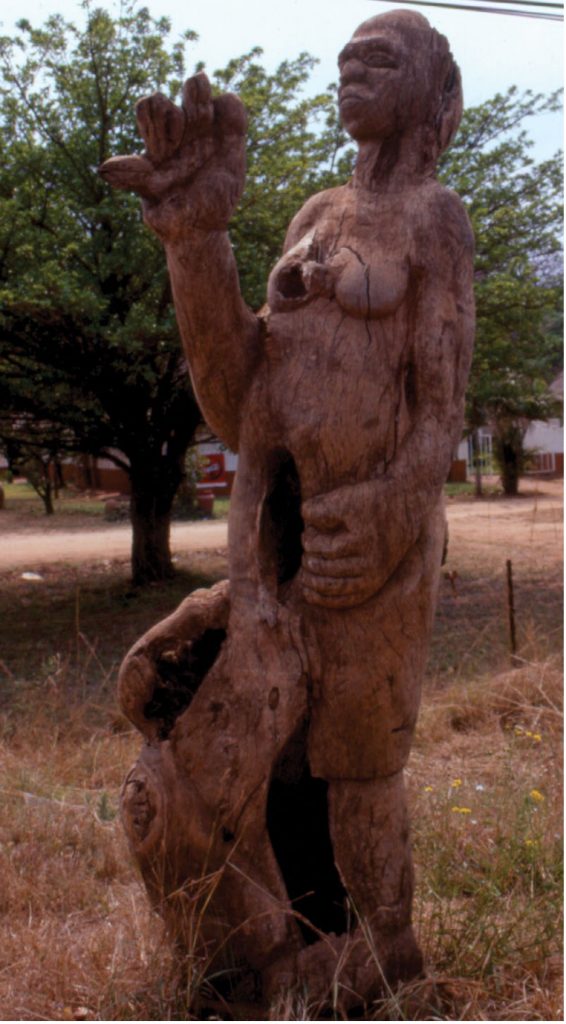
Creator woman by Raphalalani
“She is Creator of the Universe, and of Mankind…She is Creator Woman”
–Meshack Raphalalani, Venda artist describing his sculpture, 2001
“The Shekhinah¹ is considered an alternative way of thinking about God in the orthodox community… not the major way of thinking about God… but not heresy at all. It’s right there in the tradition.“ –Blu Greenberg, co-founder, Jewish Orthodox Feminist Alliance, interview, 2001
“He created me in his image so he’s inside, within me.“ – Hanna Motenda, Lemba translator at Hamangilasi village, 2001

These and other voices are heard in my dissertation, “For She Is A Tree of Life: Shared Roots Connecting Women To Deity,” an organic² theological inquiry into cultural and religious identities, beliefs and practices among South African Lemba and European American Jewish women. Despite my best efforts to remain impartial—a mindset I know to be flawed, since “objectivity” cannot exist in social science research—I look for woman in the Divine and divinity in Woman wherever I go. In both my academic research and my daily life, I constantly scan the horizon, consciously or otherwise, for maps, icons, symbols and other tangible images providing clues to the identity or presence of the ever-mysterious, intangible Sacred Feminine.
For many years I could only conceive of God as male and transcendent. During the course of my early studies this began to change; later, as I did my doctoral research, I came to see the Sacred Feminine as immanent, and deity as both female and male. How else could I image God if we are all made “in God’s image”? As I found Her in the lives and beings of other women and in myself, I was able to view even mundane activities as sacred. I saw that She was everywhere – in the ritual cleaning of pots, in the cooking and sharing of meals, in women’s secular, daily conversations and laughter even in the face of adversity.
When I learned of the female face of God within Judaism, the Shekhinah, I wondered why I had never heard about Her, why She was not part of the Jewish liturgy or ritual I experienced growing up. I did not hear anything but passing references to her as an adult and was well into adulthood by the time I found Rabbi Lynn Gottlieb’s work, She Who Dwells Within. People would sometimes say to me, at times defensively, that Shekhinah is part of Kabbalistic or mystical Judaism, but they neglected to mention that She was first written about in the Talmud, the body of Jewish oral and written laws and commentary dating back to 200-500 C.E. Others would note that Jewish women are respected for their knowledge, for holding their families together and for their communal contributions, but there was never a mention of a female Godhead or deity. And so I remained keenly aware of the patriarchy that still lived and lives within Judaism, who the decision makers are in its formal institutions, and of the absence of Shekhinah’s voice and that of the Sacred Feminine in other forms such as Asherah from most of our liturgy, chants and conversation. READ MORE
1 Defined variously as the female in-dwelling presence of God, the feminine face of God and the Hebrew Goddess.
2 Organic inquiry is a methodology in which research is treated as sacred (see Clements et al, 1999).